
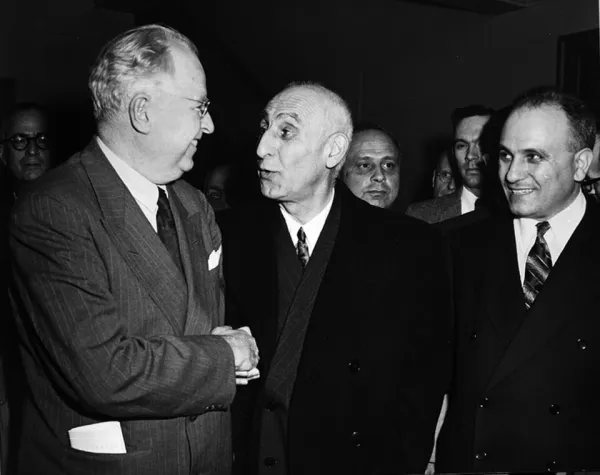
Prime Minister Mohammed Mossadegh of Iran being greeted by Henry F. Grady.jpg Harry S. Truman Presidential Library and Museum, Public domain, via Wikimedia Commons

For decades, Washington has told itself a reassuring story about Iran. The conflict, according to the conventional narrative, began in 1979 with the Islamic Revolution, the hostage crisis, and the rise of an anti-American theocracy determined to challenge the United States and its allies.
It is a convenient story. It is also historically incomplete.
The deeper reality is that America's confrontation with Iran did not emerge from a sudden ideological rupture. It emerged from the collapse of a regional order that the United States itself helped construct during the Cold War. The Iranian Revolution did not fundamentally alter American strategic objectives in the Middle East; it merely transformed the identity of the state Washington sought to contain. Before 1979, Iran was a pillar of American power. After 1979, it became the primary target of American power. The strategic architecture remained remarkably consistent. Only the role assigned to Iran changed. Viewed through a realist balance-of-power lens, the current confrontation between Washington and Tehran is not an aberration. It is the culmination of a decades-long effort to prevent the emergence of a regional power capable of challenging American influence in the Persian Gulf.
Building the Cold War Order
To understand the origins of today's rivalry and conflict, one must begin not with the Islamic Republic but with the geopolitical imperatives of the Cold War. Throughout the 1950s and 1960s, the United States sought to construct a regional order that would protect Western access to oil, contain Soviet expansion, and suppress nationalist movements perceived as destabilizing or vulnerable to communist influence. The Middle East was not merely another theater in the Cold War; it was becoming the world's most strategically important energy corridor.
Two states became central to this vision: Iran under Shah Mohammad Reza Pahlavi and Israel.
The decisive moment came in 1953 when the United States and Britain orchestrated the overthrow of Iran's democratically elected prime minister, Mohammad Mossadegh, after he nationalized Iran's oil industry. American officials justified the operation as necessary to prevent communist influence and safeguard regional stability. Yet Mossadegh was fundamentally a nationalist rather than a Soviet proxy. His challenge was directed at Western control of Iranian resources, not at capitalism itself.
The coup revealed a recurring feature of American foreign policy: when strategic interests and democratic principles collide, strategic interests usually prevail. Washington's support for the Shah extended far beyond diplomatic recognition. With assistance from American and Israeli intelligence services, Iran established SAVAK—the National Organization for Intelligence and Security—in 1957. Designed to protect the monarchy and suppress internal opposition, SAVAK became one of the most effective and feared intelligence organizations in the region.
Although no formal tripartite alliance existed, the overlapping interests of Washington, Tehran, and Jerusalem produced a de facto strategic alignment. Iran served as a bulwark against Soviet influence on the southern frontier. Israel functioned as a counterweight to hostile Arab states. The United States stood behind both as the ultimate guarantor of regional order. This arrangement reflected classic realist logic. Washington sought not to transform the Middle East politically but to stabilize it strategically. Regional partners would maintain order while the United States avoided the costs and risks of direct military involvement.
Iran as America's Regional Enforcer
By the 1970s, this strategy had evolved into the so-called "Twin Pillars" doctrine, with Iran and Saudi Arabia acting as the primary guardians of American interests in the Gulf. Iran occupied a uniquely valuable position. It bordered the Soviet Union, commanded access to the Persian Gulf, possessed vast energy resources, and maintained one of the region's most capable militaries. The Shah received advanced American weapons and political backing in exchange for serving as a regional security guarantor.
From a realist perspective, this was offshore balancing at its most effective. Rather than deploying large numbers of American troops, Washington delegated responsibility to local partners capable of preserving a favorable balance of power. Iran helped counter Soviet influence, contain Iraqi ambitions, and challenge the rise of radical Arab nationalist movements led by figures such as Gamal Abdel Nasser. Far from being viewed as a threat, Iran was regarded as one of the central pillars of American strategy in the Middle East.
Then the revolution arrived.
The Revolution Changed the Target, Not the Strategy
The 1979 Iranian Revolution destroyed the political foundation of the existing regional order. The Shah fell. The strategic triangle linking Washington, Tehran, and Jerusalem collapsed. The new Islamic Republic rejected American influence and positioned itself as a revolutionary force opposed to the regional status quo.
Yet while Iran's identity changed dramatically, America's strategic objectives did not. The Persian Gulf remained vital to global energy markets. The United States still sought to prevent hostile powers from dominating the region. Washington still required a favorable balance of power to protect allies and maintain access to critical resources. The architecture survived. The cornerstone disappeared. In realist terms, Iran underwent a transformation from status quo partner to revisionist power. Once integrated into the American-led order, it now challenged that order. The response from Washington was almost inevitable.
Containment Redirected
The Iran-Iraq War became the first major test of America's post-revolution strategy. Washington did not support Saddam Hussein because it admired his regime. Saddam was authoritarian, brutal, and hardly aligned with American values. But realism rarely concerns itself with values alone. American policymakers feared that an outright Iranian victory could destabilize Gulf monarchies, expand Tehran's influence, and fundamentally alter the regional balance of power. As a result, the United States provided intelligence, diplomatic support, and indirect assistance designed to prevent Iran from achieving decisive success.
The objective was not conquest. It was containment.
This reflected a classic balance-of-power strategy. When a state appears capable of upsetting regional equilibrium, rival powers organize to prevent it from becoming dominant. For the first time since 1953, Iran was no longer serving America's balancing strategy. It had become the object of it.
The Rise of America's Permanent Gulf Presence
The end of the Cold War introduced a new strategic challenge. For decades, Washington had relied on regional partners to preserve stability. But the 1991 Gulf War weakened Iraq, one of Iran's principal rivals, and raised questions about whether local balancing alone could sustain the regional order. The United States responded by dramatically expanding its own presence. Military facilities proliferated across Saudi Arabia, Bahrain, Qatar, Kuwait, and the wider Gulf. The Fifth Fleet expanded its role. Pre-positioned equipment and rapid deployment capabilities transformed the region into a permanent arena of American military power. This represented a shift from offshore balancing to forward containment.
Realist theory predicts such a transition. When local partners become incapable of maintaining equilibrium, great powers often intervene directly to prevent power vacuums from emerging. With Iraq weakened and the Soviet Union gone, Iran increasingly appeared to be the only regional actor capable of challenging American influence on a systemic level. Washington embedded itself in the Gulf to ensure that challenge never materialized.
The Iraq War's Strategic Contradiction
The 2003 invasion of Iraq exposed one of the greatest weaknesses in American grand strategy.
By removing Saddam Hussein, the United States eliminated a hostile regime. It also eliminated Iran's most important regional counterweight. The consequences were profound.
Iran expanded its influence in post-Saddam Iraq, strengthened ties with Hezbollah in Lebanon, deepened its involvement in Syria, and cultivated networks extending into Yemen. Much of what American policymakers later described as Iranian expansion was enabled by the collapse of the very state that had previously constrained Iranian ambitions. From a balance-of-power perspective, the Iraq War was a strategic paradox. A war intended to strengthen American influence inadvertently improved Iran's relative position. Washington responded predictably. Concerns about Iranian influence intensified. Economic sanctions expanded. Military partnerships deepened. Regional coalition-building accelerated. The strategic objective remained unchanged: prevent Iran from translating growing influence into regional dominance.
The Coalition Era
The most recent phase of American strategy has relied on integrating regional partners into a more cohesive security architecture. Missile defense systems have become increasingly interconnected. Intelligence sharing has expanded. Joint military exercises have multiplied. Security cooperation between Israel and several Gulf states has grown closer than at any point in modern history. This development is often portrayed as a novel response to emerging threats.
In reality, it represents a modernized version of the same balancing logic that has guided American policy for decades. The United States is assembling a coalition designed to constrain the influence of a perceived regional challenger. The tools are different. The objective is not. What once relied on the Shah's military now relies on integrated air defenses, intelligence networks, sanctions regimes, naval deployments, and regional partnerships. The underlying strategic purpose remains remarkably consistent.
The Great Irony
The central irony of U.S.-Iran relations is impossible to ignore.
The United States spent decades helping transform Iran into a powerful regional actor. It supported the Shah. It helped build Iran's notorious security apparatus SAVAK. It armed and financed the regime. It integrated Tehran into a broader regional order alongside Israel and conservative Arab monarchies.
Iran was valuable precisely because it strengthened the balance of power Washington sought to maintain. After 1979, that same geopolitical weight became a problem. Iran's geography did not change. Its population did not change. Its strategic location did not change. What changed was its willingness to serve American interests.
The architecture endured. The target shifted. This reality challenges popular narratives that reduce the conflict to ideology, religion, or personalities. Revolutionary rhetoric certainly matters. So do domestic politics and historical grievances. But they cannot fully explain the remarkable continuity of American strategy across multiple administrations, parties, and generations. Realists would argue that power, geography, and strategic position provide a more convincing explanation.
The War We Were Always Moving Toward
Whether the current war with Iran escalates into a broader conflict or settles into another uneasy stalemate, it should not be viewed as a sudden departure from history.
It is the latest chapter in a strategic process that began when revolutionary Iran ceased being a pillar of the American order and became an independent center of regional power.
For more than four decades, Washington has pursued the same fundamental objective through evolving means: proxy balancing in the 1980s, military entrenchment in the 1990s, sanctions and coercive pressure in the 2000s, and integrated regional coalitions in the 2010s and 2020s.
The methods changed. The logic did not.
The uncomfortable lesson is that the United States did not develop a new grand strategy after the Iranian Revolution. It simply redirected an existing one.
America's overriding goal has remained constant: prevent the emergence of a hostile regional hegemon capable of dominating the Persian Gulf, threatening critical energy routes, undermining allied governments, or challenging U.S. primacy.
Before 1979, Iran was the cornerstone of that strategy.
Since 1979, it has been the principal obstacle to it.
The revolution changed the actors.
It did not change the Washington’s script.